
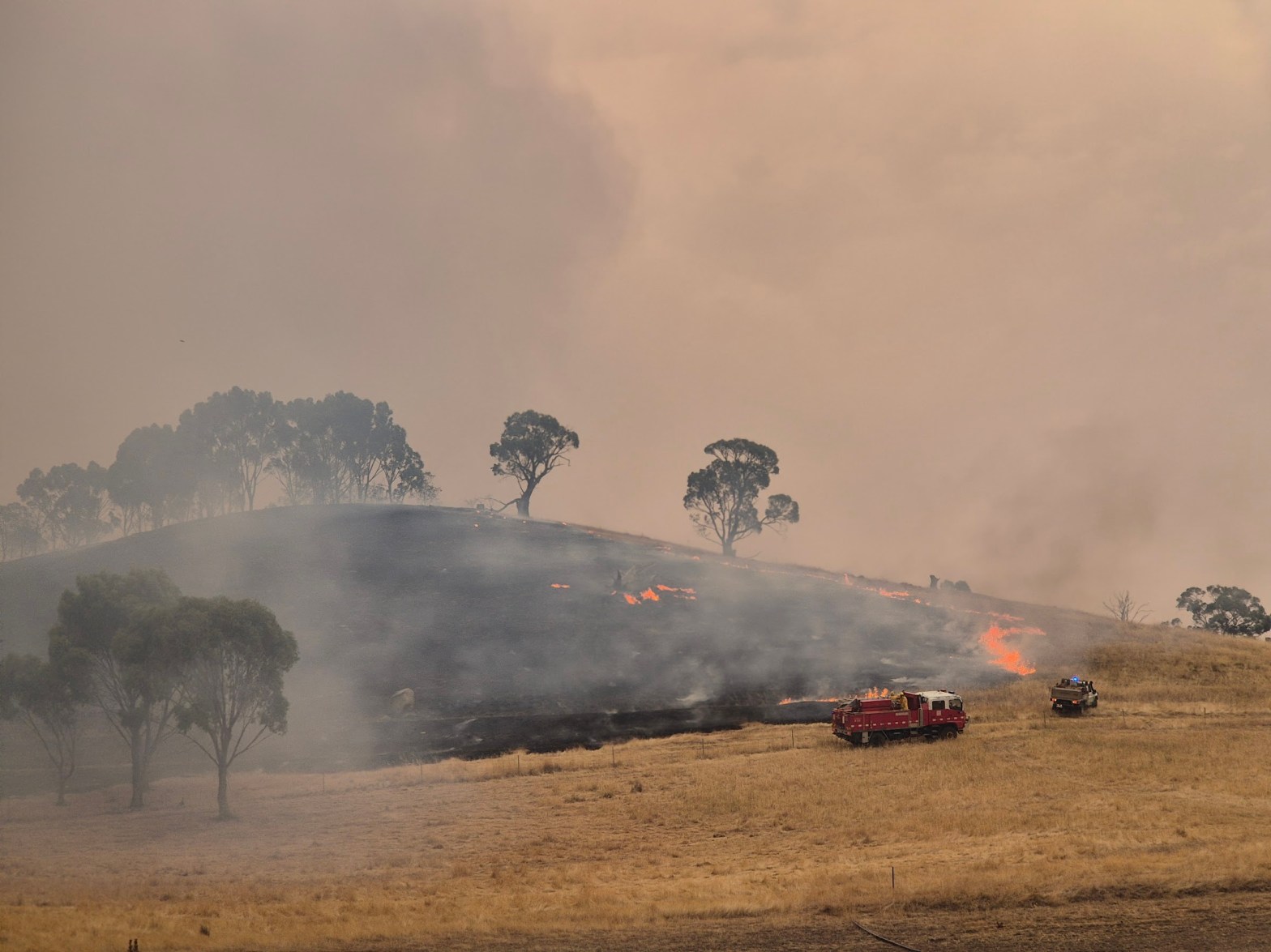
The 2025/6 summer fires had a devastating impact on communities across Victoria.
‘More than 440,000 hectares of land were burnt. 451 homes were destroyed, a further 1,110 outbuildings lost, and many businesses were severely affected. It is estimated that more than 45,000 livestock deaths were recorded, as well as an incalculable loss of wildlife’.
After the fires, the Victorian Legislative Council agreed to the following motion:
‘That this House requires the Environment and Planning Committee to inquire into, consider and report, by 1 June 2026, on the 2026 summer fires across Victoria’.
After receiving more than 450 submissions and holding multiple public hearings, the Committee delivered its report in July. We commend the members of the committee – and all the unseen support staff – who both listened to the community and delivered a comprehensive report into the fires, including preparation, response and recovery, and we broadly agree with the findings and recommendations contained in the final report. Both The Greens and The Liberal and National party members of the committee also delivered minority reports. The report itself is well worth reading if you have any interest in the area of disaster preparation, response and recovery.
There is some detail in the report that demonstrates that the conservative parties represented on the committee – including MPs from The Liberals, The Nationals, and Pauline Hanson’s One Nation – allowed their preoccupation with ideology to over-ride their willingness to accept the advice of mainstream science.
Legislative Council Standing Order 23.20(5) requires the Committee to include in its report all divisions (where a vote has been called) on a question relating to the adoption of the draft report. All Members have a deliberative vote. In the event of the votes being tied, the Chair also has a casting vote.
In the preparation of the report, Greens MP Aiv Puglielli moved that in Chapter 3, Section 3.2.1, the following finding be inserted:
Finding: Climate change is a key contributor to bushfire conditions and in contributing to the frequency and severity of bushfires in the state.
This is consistent with mainstream science and the views of almost every firefighting agency in Australia, and would not be a controversial issue for anyone familiar with the scientific consensus on the topic.
Yet the conservative members of the committee – Melina Bath, Gaelle Broad, Wendy Lovell and Rikkie‑Lee Tyrrell all voted against the text. It was approved through the Chair using their casting vote and appears as Finding 2 in the report.
There is a summary of the position of experts and fire agencies available here, which outlines the consensus that human induced climate change is driving longer fire seasons and more intense fire activity. In pre season reporting for the 2026/27 fire season, Chris Hardman, Forest Fire Management Victoria chief fire officer, recently noted that “it certainly appears” that repeated high bushfire predictions may be the new normal.
He went on to say that “with climate change, and on average we are getting about 15 per cent less spring rain than we used to get back in the 1970s and 1980s, and without the spring rain, that inevitably leads to higher-than-average bushfire seasons” (story link here).
Rural and regional communities are on the frontlines of climate change impacts – we experience ever worsening fire seasons, flooding, heatwaves and storm surge directly. We see infrastructure, like roads, communications, farm and other human assets like houses damaged by these events.
Without concerted action to reduce greenhouse gas emissions at a local to global level, then the impacts of climate change will continue to increase, causing more financial, emotional and physical damage to rural communities. While we understand that climate change denial is largely based on cultural identification, it is still deeply disappointing to see conservative MPs, who are meant to serve the interest of their constituents, rejecting mainstream science in favour of cultural allegiance to climate change denial.
You can read the committee report here.


One thought on “Libs, Nats and PHON abandon regional communities to worsening disaster”