
People who oppose renewables love to talk up the perceived fire risks of wind turbines, batteries and electric and hybrid vehicles. And when accidents do happen, news is spread on social media which generates a sense that these events are common and pose unacceptable risks to firefighters, the environment and the community.
The fact is that the risk of fires in all of these facilities is actually very low. There are more than 350,000 electric vehicles (EVs) on Australian roads (July 2025), yet to the best of our knowledge there have only been 7 on road accidents where the battery pack has ruptured and the cells have gone into thermal runaway (when a battery cell short circuits & starts to heat up uncontrollably). Electric vehicle battery fires are rare. Indeed, the available data indicate the fire risk is between 20 and 80 times greater for petrol and diesel vehicles.
A current news story that is circulating involves commentary of a recent fire from the USA:
‘Five Sacramento firefighters were hospitalized after responding to a Tesla crash. The vehicle’s battery pack had been compromised, scattering hundreds of cells across the roadway. When the tow truck tried to move the Tesla, the main pack reignited, releasing a massive vapor cloud that traveled hundreds of feet downwind.
These weren’t just flames — this was a toxic mix of hydrogen fluoride, carbon monoxide, and vaporized solvents like ethyl and dimethyl carbonate. The result: four firefighters still off duty months later with lasting respiratory, cardiac, and renal complications.’
To have a battery pack release cells across the roadway is *very* rare. There is a video circulating which describes this incident, which is worth a watch. It outlines how the firefighters were caught in vapours and the need to stage well back from a fire and use breathing apparatus. As the narrator says ‘we’re going to have to change our tactics’.
However, bad faith actors often amplify these sort of events to try and convince people that new technologies that they don’t like are incredibly dangerous.
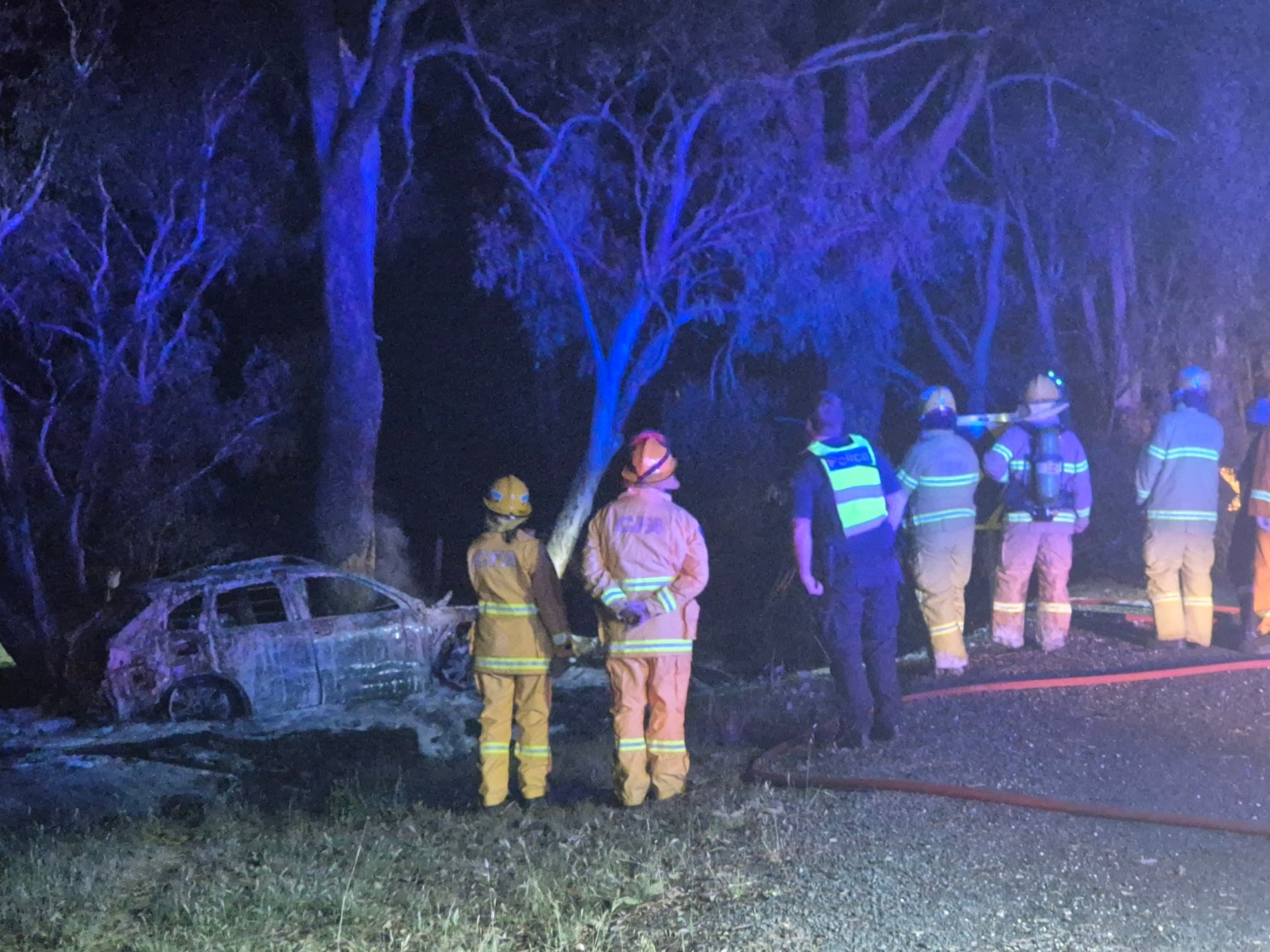
The photo used in the header of this story is from a hybrid fire I attended in NOV 2024 in central Victoria. The battery pack was ruptured and went into thermal runaway. When we arrived I was the only person on scene who had breathing apparatus (BA) qualifications so all firefighters moved back to a safe distance while I worked to contain the fire. In many ways it was a routine car fire.
Firefighters are constantly learning new skills and techniques. Battery fires are now a part of life. These events are manageable – we just need to learn how to respond safely.
There are things we need to consider, like:
– knowing the safe standoff distances for people not in BA,
– ensuring that the public is kept back beyond a normal exclusion distance
– knowing how to react to the fire itself (fighting one of these fires is very different to an internal combustion engine fire)
– ensuring decontamination of any gear used near the fire
There is lots of great training opportunities and information out there.
We suggest the resources available via EV Firesafe: https://www.evfiresafe.com/
And check the AFAC website: https://www.afac.com.au/public-resources/volunteers-embrace-the-new-response-to-electric-vehicle-incident—foundation-training-program
Are electric vehicle fires common? https://electricvehiclecouncil.com.au/docs/are-electric-vehicle-fires-common/
Electric vehicle fires are very rare. https://theconversation.com/electric-vehicle-fires-are-very-rare-the-risk-for-petrol-and-diesel-vehicles-is-at-least-20-times-higher-213468
Queensland Fire Department briefing sheet on responding to EV fires and incidents: https://www.fire.qld.gov.au/safety-education/battery-and-charging-safety/electric-vehicle-fire-safety
Don’t believe the anti renewables hype!
 Australian Firefighters Climate Alliance