
The biennial State of the Climate Report, which is produced by the CSIRO and BOM has now been released. The report draws on the latest national and international climate research, monitoring, science and projection information to describe changes and long-term trends in Australia’s climate. Among a vast amount of information, there are some clear details relevant to firefighting in a warming climate.
This is the AFCA response to the section of the report on fire.
Firefighters know that climate change is already leading to longer and more intense fire seasons. This has a range of impacts on us and our capacity to fight blazes. Already there are greater demands on firefighters, and many volunteer agencies are struggling to maintain volunteer numbers. Some impacts include:
- There are greater demands on firefighters and their families and their support networks due to longer seasons
- Firefighters often live in rural and regional areas, where the impacts of fire on the local community can add to the mental health impacts on firefighters
- Volunteers are in many instances finding it financially harder to afford to be away on longer fire seasons
- With more extreme weather such as flooding, and greater demands on firefighters to assist in recovery efforts (for instance when CFA crews were sent to northern Victoria in the spring of 2022 to assist with flood recovery efforts) overall demands on the time of volunteers increases. This is often known as Compound disasters, where climate change is causing a combination of extreme weather events to occur at the same time or close together that can then lead to impacts that exceed the sum of the individual contributing events
- The support services that provide behind the scene infrastructure for large campaign fires (food, accommodation, etc) are also involved in flood and other disaster response and recovery efforts, increasing burden on them (this includes organisations like the Red Cross and the SES)
- There is more damage to human assets and the natural environment and greater economic impacts as a result of climate change super charging fire seasons
Additionally, as fire seasons get longer in both hemispheres this also brings additional impacts on firefighters. During the Black Summer of 2019/20, around 1,000 people came to Australia from North America to assist in our firefighting efforts. We sent crews to North America during their current difficult fire season. We also lease in some of our firefighting aircraft from North America (especially the Large Air Tankers, or LATs, which are essential in our firefighting efforts). Longer seasons, with shorter ‘shoulder’ periods means ever more demands on firefighters.
What should we do?
As was noted by the ABC, the report has a clear message – the world is sick, it’s addicted to fossil fuels and the only way to bring the temperature down is to get off them.
That’s why AFCA focuses on the need for Australia to radically reduce greenhouse gas emissions now.
We also need to continue to fund career firefighters, recruit and support volunteer firefighters, and maintain our air fleet capacity (including establishing a publicly owned fleet of LATs).
The report
What the report says about Fire weather
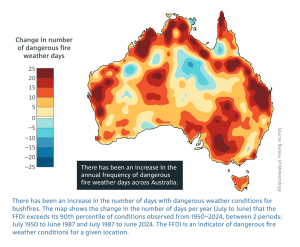
Excert from the report:
There has been an increase in extreme fire weather, and in the length of the fire season, across large parts of Australia since the 1950s. This has led to larger and more frequent fires, especially in southern Australia.
The influence of climate change on bushfires varies across Australia, depending largely on the kinds of vegetation (fuel) which grow in each region. Climate change is driving changes in temperature, rainfall, and relative humidity, all of which influence fuel availability, fuel dryness, fire weather, and ignition sources.
Fire weather (often hot, dry and windy) is a significant contributor to fire risk in forest fuel areas of southern and eastern Australia. Conversely, wetter conditions in northern and central regions results in abundant grassy fuel loads, which is a key contributing factor to fire risk in those regions.
There is a notable trend in some regions of southern Australia towards more days with weather that is conducive to generating thunderstorms within smoke plumes. These fire-generated thunderstorms can lead to extremely dangerous fire behaviour, such as during the Black Summer fires (2019–2020), the Victorian Black Saturday fires (2009), and the Canberra fires (2003). New fires can be ignited from lightning strikes produced by these thunderstorms.
The report also notes that:
Lightning that occurs without significant rainfall (known as ‘dry lightning’) is a major source of natural ignition for bushfires. Understanding changes to bushfire ignition in Australia, including the frequency of dry lightning, is a current area of active research.
You can find the report here.
There is a good summary via the ABC here.
 Australian Firefighters Climate Alliance